1) What’s the game goal? Is it clear? Is it compelling to me? Why or why not?
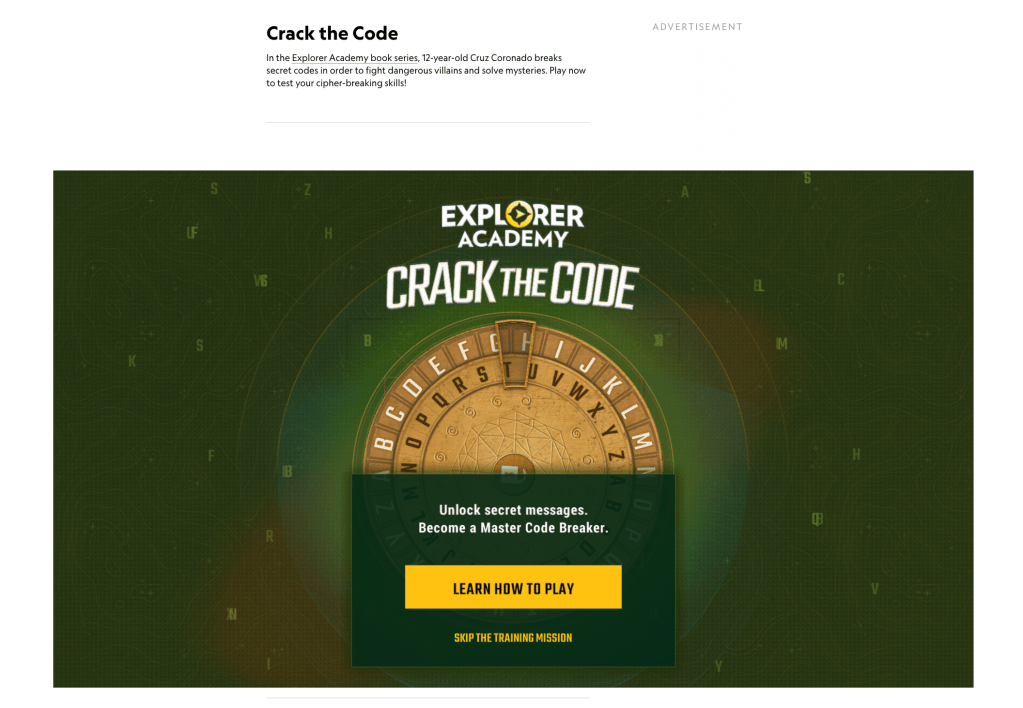
This game’s goal is to improve the critical thinking and problem-solving skills of the user by breaking secret code in order to solve mysteries and villains. The game’s goal is clear because this game presented its main goal at the top of the game and this game has a section called “Learn How To Play” on the home page includes the main goal of the game and tutorial to help the user to play the game.
2) What’s the game’s core dynamic? Is it exploration, collection, “race to the finish,” solve—or a blend of two different dynamics such as collection AND race to the finish?
The tutorial shows that this game’s core dynamic is the exploration and solve because the user needs to explore different ways to break the codes to solve the next mystery.
3) Are the rules clear? How do I learn them?
The rules are clear. I learned them by clicking on a tab on the home page of the game called “Learn How To Play”. This section includes a tutorial of how to play the game and the rules are presented well in this tutorial.
4) What game mechanics (aka rules) make the game most fun? Which one(s) would I change? What would happen if I did?
The two spinning wheels that are used to match letters to make a word to go to the next mysteries make the game the most fun. I think I would make it three spinning wheels instead of two spinning wheels to make the game more challenging. This change would make the user spins three wheels to make a word to go to the next mystery.
5) Do the aesthetics of the game draw me in? What emotional reaction do the aesthetics elicit in me?
The aesthetics of the game draw me in. The aesthetics of the game make me feel that I’m inside a mystery chamber and I have to solve the code to open the door. They make me feel the mysterious vibes.
6) Is the game “balanced” in the sense that it accommodates different player levels? How?
Yes, this game is “balanced” in the sense that it accommodates different player levels. It starts with an easy level in which the user has to create an easy word to open the gate then the user goes to different mysteries with different levels and it becomes harder in each mystery.
7) What’s the balance between strategy and chance? Do I feel like I have control over the outcome by the choices I make in the game or do I feel the outcome is almost all chance?
The user has to make his own strategy to solve the cipher code and the user has unlimited chances to repeat his try to solve the cipher code. I feel like I have control over the outcome by the choices I make in the game.
8) Is the game cooperative, competitive, or a blend of both?
This game is competitive because I challenge myself to solve the cipher code.
9) If the game is competitive and I lose, how does this make me feel? Does it motivate me to play again or do I want to avoid playing again so I can avoid losing?
It makes me feel that I have to challenge myself to get the code. It motivates me to play again.
10) If it’s a digital game, how easy is it to navigate? Can I quickly learn by exploring?
I think it will be hard to learn how to play the game by exploring. I think it necessary for me to watch a tutorial on how to play this game to know the rules of the game.
11) Finally, as a learning game designer, what elements from this game could I use in a game I design?
I think I could create a tutorial on how to play my game to make it easy for the user to understand the rules and the core dynamic of my game.
 Critical Play Reviews