Featured

Ahmed Saleh

Welcome to My New Blogs for Serious Game Class (477:01)

Part 1: DEFINING [SERIOUS] GAMES:

Stenros stated, “A game implies someone who enacts the game, performers usually called players, but also decision-makers, participants, contenders, people, as well as adversaries and teammates” (Stenros p.507). Games are defined as work that involves individuals or teams and has some specific rules. The game should be interactive that is governed by certain rules in which players are evaluated, and it runs on computers, mobile phones, or TV.  The game depends largely on the use of the mind and on the intelligence of the person and the ability to make decisions like in chess. These games fall between ease and difficulty, which depend heavily on graphics, which leads to a lot of attraction to them. According to the “Current Practices in Serious Game Research” article, the serious games is “a computer-based game with a primary purpose other than entertainment, ranging from anywhere between advertisements to military training exercises” (p.233).  The serious game is a type of games that raise the level of the academic and social skills of people, such as the skill of writing, searching for information, and the skill of acquiring new foreign languages, in addition to the skills of solving problems facing them, and critical thinking skills. The serious games introduce the players to the world around them and introduce them to new environments and experiences that they have not tried before. The serious game has the ability to raise the level of concentration of the players, in addition to raising the efficiency of memory and observation.

Part 2: APPLYING YOUR DEFINITION OF A SERIOUS GAME TO A SERIOUS GAME

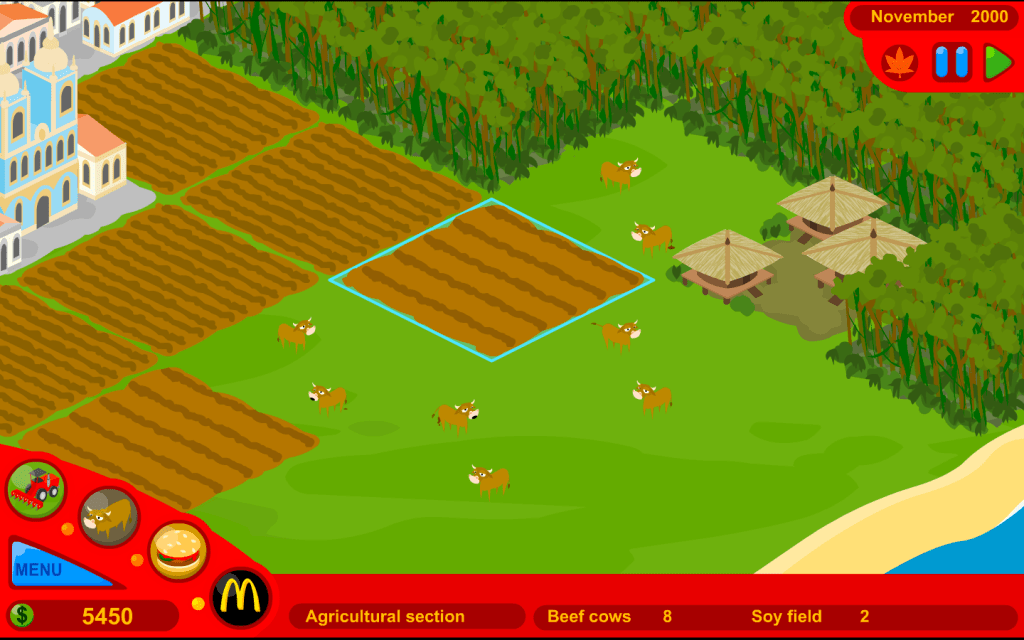
According to the “Current Practices in Serious Game Research” article, playing a serious game is “ a complex task, even when an appropriate design was chosen for the intended learning outcomes: Players have to visually attend different locations on the screen, coordinate this with mouse or joystick movement, interpret verbal cues, and solve problems that occur during the game-play”(P.243). I played McDonald’s videogame. I consider this game as a serious game because it fits the criteria for a serious game. This is based on critical thinking and it develops problem-solving skills. In McDonald’s videogame, I have to make sandwiches but I have to go through a complex process to make the sandwiches. I have to create pastures then slaughter some cows then send vegetables and cow beef to the restaurant. At the end of this process, I start to prepare the components of the sandwich. All these steps need the player to have problem-solving skills because each step in the process has its challenges. This game introduces me to a new environment and makes me try new things that I haven’t tried before. McDonald’s videogame makes feel that I’m the owner of McDonald’s and I’m responsible for everything in this business. I think that this game has the ability to raise my level of concentration and improve my efficiency of memory and observation.
Critical Play Journal – Entry 2

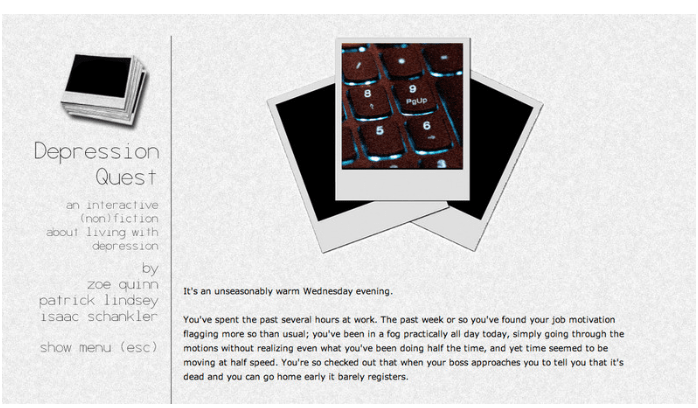
I played a game called is “Depression Quest”. This game is considered as a serious game because it has the characteristics of serious games. In this game, I played as an individual who is suffering from a deep depression. This game gave me daily life events and the rule of this game is to manage these events including my relationships, illness, and job issues. I have to find the best possible treatments for each of these events. This game has a goal which is making the players feel and understand what depression can do to people. This game makes the player feels the feelings that depressed people feel.

It has rules and a goal, and these are the characteristics of serious games. Depression Quest game improves the self-direction, responsibilities, and reflective learning skills.  This type of game empowers “participants with a sense of responsibility and setting appropriate and flexible boundaries helped motivate the game participants” (Schrier, p.7). It gives the player the responsibility to manage the life events that are assigned to the player. This game increases the social and community awareness of the player because it puts the player in the position of the depressed people and makes the player views the world from their point of view to understand their illness. This game makes the participants aware of different viewpoints.
Link: https://the-quinnspiracy.itch.io/depressionquest

Critical Play Journal – Entry 4 (Gamestar Mechanic)

The Gamestar Mechanic focuses on making students learn the game design process by themselves. In Gamestar Mechanic, the idea is to transfer game design skills to students without the intricacies of programming to create their own games and help them to develop other skill sets such as language, systematic thinking, problem-solving through simulation, trial, storytelling, etc. The Gamestar Mechanic makes the students interested to create games because it gives them the ability to edit games and create their own games. This makes students gain the 21st-century skills such as problem-solving, critical thinking, information literacy, and creativity. The Gamestar Mechanic is considered a serious game because it helps students to learn and experience new things like creating games that develop their skills. It gives students instructions to help them to work on their problem-solving and critical thinking skills. The serious games are the games that use “pedagogy to infuse instruction into the gameplay experience [3, 4] – is relevant, because a large and growing population is familiar with playing games, that can present users with realistic and compelling challenges, highly stimulating their information processing capabilities and capturing their concentration span for long duration” (Bellotti, P.22). In Gamestar Mechanic, students gain a good amount of information about creating games through different learning levels, after that, they start to create their game characters, storyline, and environment.
Critical Play Journal – Entry 5

My Critical Take on Scratch:

I haven’t used Scratch in a previous class and I haven’t used any learning materials or had any learning experiences that reminded me of learning with Scratch. The hands-on resources were very useful for me because it gave me a general thought of game design. I played an escape room game during class. I played “Tsunami Run”, “Wave Escape”, and “Bully Game” from the Scratch website. I played well all three games. However, there were some glitches happened while I was playing the “Tsunami Run” game.  

(Scratch)

1) What are the systems?

There are three main tabs at the top of the home page of Scratch. One for creating projects, one for exploring projects, and one for project ideas. There are Scratch programs are called objects, which are graphics that can be programmed and made to move or play music clips or interact with other objects. I can change the look of the object by giving it an appearance and any digital image can be used as an appearance.

2) What are the systems about?

Scratch is a type of simple, easy-to-learn programming that was developed to make learning programming fun and easy for beginners and children. Scratch helps the user to understand the basics of programming, along with some mathematical concepts, such as the coordinate system, and random numbers in stimulating ways of learning, so that the user acquires many of the necessary skills. Scratch users can visualize their ideas, in the form of animations, art games, and other good ideas of using photos, videos, or any kind of media through which the user can provide distinctive and creative projects.

3) How do I touch the system, and how does it touch me?

I think it is a distinctive tool through which the different programming languages are learned and it is the basis of the programming language known as graphics programming. Scratch allows me as a user to make games and combine pictures and music and many other things using programming. Also, it gives me the ability to design characters that can perform a range of movements such as dance and sing or dealing with other characters and objects. 

4) What is the game experience?

In Scratch, I learn logic, the basics of analysis, and how to build and plan a project through the sources that Scratch provides such as exploring new projects and new ideas and the algorithm of the projects.

5) What is the experience about?  

All the sources and tabs that Scratch has, help the users to learn programming in an easy and simple way, without the complications of the code. The professionalism of Scratch’s design made it a powerful and effective tool that contributes greatly to facilitating the creation of games and interactive stories and many uses in which if the user relies entirely on the codes, he will need a great effort and more time and perhaps even not to reach the required result.

6) Do these things all match up?

Yes, I think all these things make gestures towards the same goal which is developing the innovation and creativity of the user to create creative games.

7) What about fun?

The fun and simplicity of the program lie in that instead of codes that carry a lot of complexity, it uses graphical objects, so that the language that Scratch provides is very similar to being a game and not a literal programming language. Also, through the features and capabilities offered by the program, it really overcomes the difficulties and problems that Programmers face while working on other programming languages. Scratch prevents the user from the technical or programmatic obstacles and opens the way for the user to develop creativity and innovation by making it possible for projects to be implemented.

Journal – Entry 3

Link: https://kids.nationalgeographic.com/games/action-and-adventure/crack-the-code/

1) What’s the game goal? Is it clear? Is it compelling to me? Why or why not?

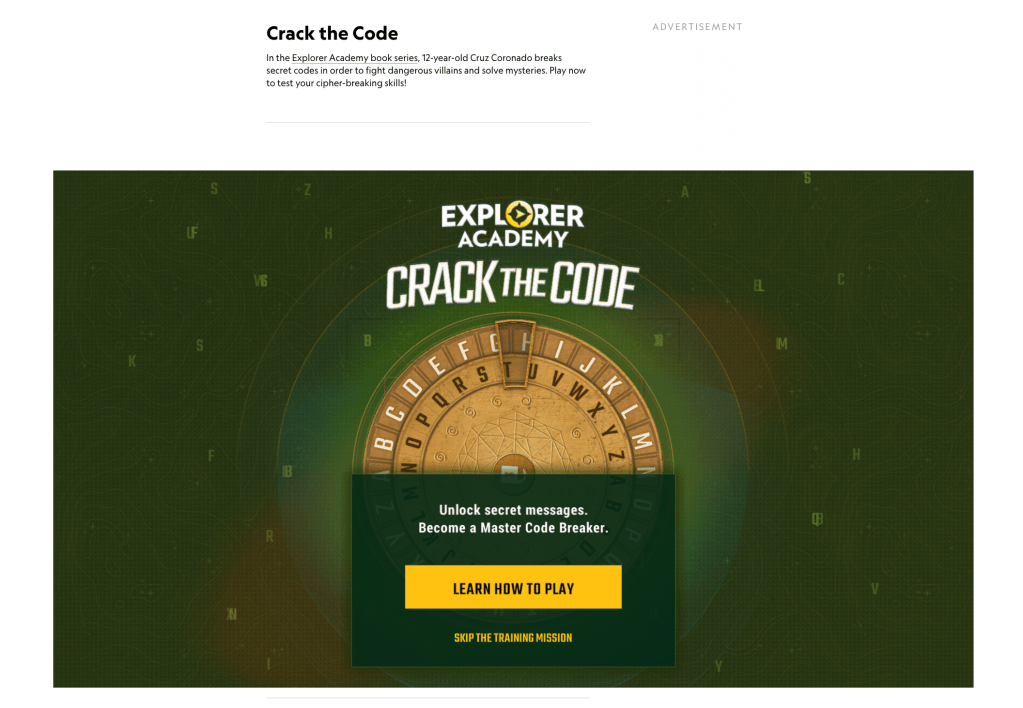
This game’s goal is to improve the critical thinking and problem-solving skills of the user by breaking secret code in order to solve mysteries and villains. The game’s goal is clear because this game presented its main goal at the top of the game and this game has a section called “Learn How To Play” on the home page includes the main goal of the game and tutorial to help the user to play the game.

2) What’s the game’s core dynamic? Is it exploration, collection, “race to the finish,” solve—or a blend of two different dynamics such as collection AND race to the finish?

The tutorial shows that this game’s core dynamic is the exploration and solve because the user needs to explore different ways to break the codes to solve the next mystery.

3) Are the rules clear? How do I learn them?  

The rules are clear. I learned them by clicking on a tab on the home page of the game called “Learn How To Play”. This section includes a tutorial of how to play the game and the rules are presented well in this tutorial.

4) What game mechanics (aka rules) make the game most fun? Which one(s) would I change? What would happen if I did? 

The two spinning wheels that are used to match letters to make a word to go to the next mysteries make the game the most fun. I think I would make it three spinning wheels instead of two spinning wheels to make the game more challenging. This change would make the user spins three wheels to make a word to go to the next mystery. 

5) Do the aesthetics of the game draw me in? What emotional reaction do the aesthetics elicit in me?

The aesthetics of the game draw me in. The aesthetics of the game make me feel that I’m inside a mystery chamber and I have to solve the code to open the door. They make me feel the mysterious vibes.

6) Is the game “balanced” in the sense that it accommodates different player levels? How?

Yes, this game is “balanced” in the sense that it accommodates different player levels. It starts with an easy level in which the user has to create an easy word to open the gate then the user goes to different mysteries with different levels and it becomes harder in each mystery.

7) What’s the balance between strategy and chance? Do I feel like I have control over the outcome by the choices I make in the game or do I feel the outcome is almost all chance? 

The user has to make his own strategy to solve the cipher code and the user has unlimited chances to repeat his try to solve the cipher code. I feel like I have control over the outcome by the choices I make in the game.

8) Is the game cooperative, competitive, or a blend of both?

This game is competitive because I challenge myself to solve the cipher code.

9) If the game is competitive and I lose, how does this make me feel? Does it motivate me to play again or do I want to avoid playing again so I can avoid losing?

It makes me feel that I have to challenge myself to get the code. It motivates me to play again.

10) If it’s a digital game, how easy is it to navigate? Can I quickly learn by exploring?

I think it will be hard to learn how to play the game by exploring. I think it necessary for me to watch a tutorial on how to play this game to know the rules of the game.   

11) Finally, as a learning game designer, what elements from this game could I use in a game I design?

I think I could create a tutorial on how to play my game to make it easy for the user to understand the rules and the core dynamic of my game.

Design a site like this with WordPress.com
Get started